




Boron Steel vs Carbon Steel Wear Plates: Which Material Suits Your Bucket?
Summary: About blog: Compares boron steel and carbon steel wear plates on hardness, toughness, weldability and cost. Includes a table matching each material to ground type, and a short list of questions to ask a wear plate manufacturer before you order.
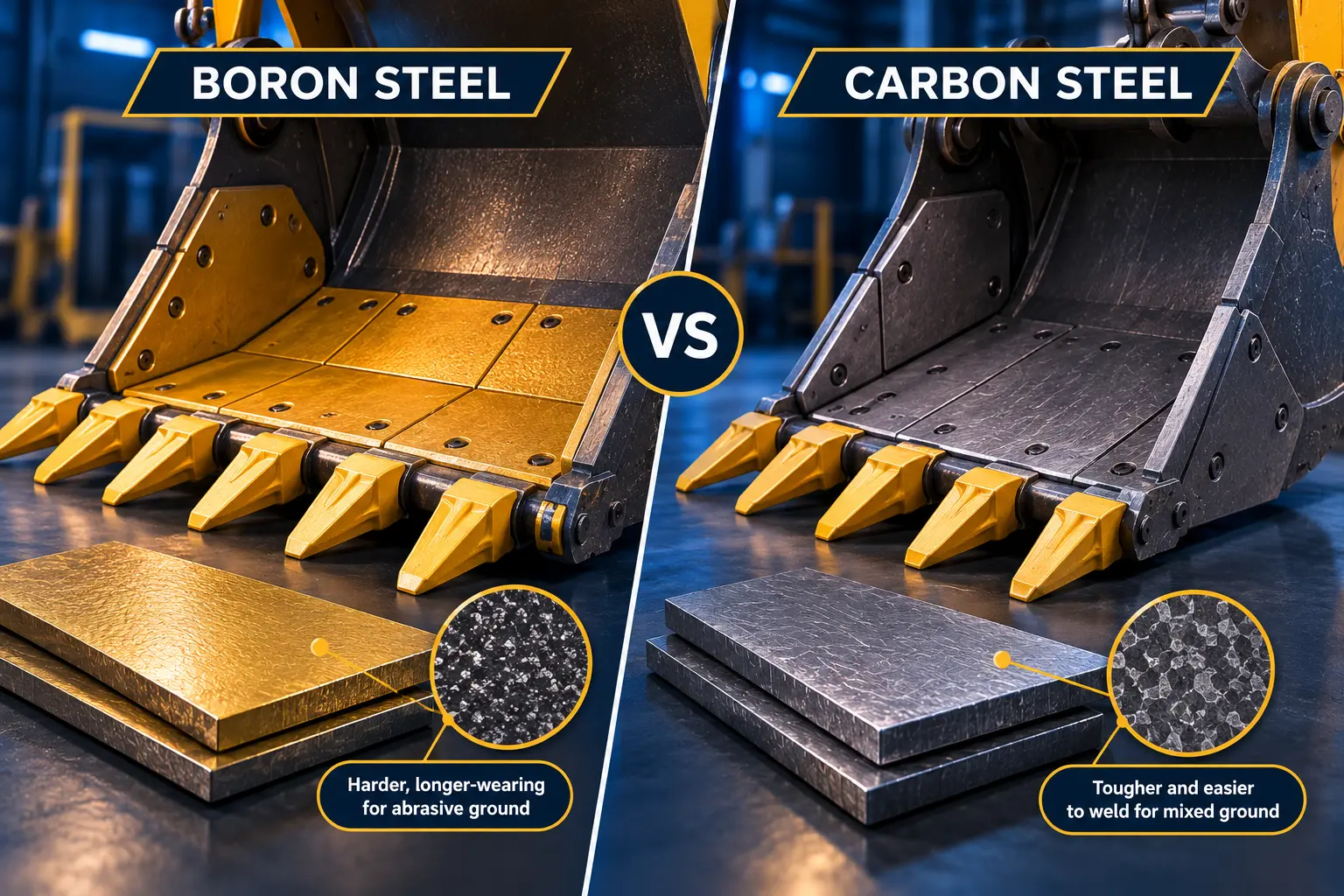
A bucket spends its life being scraped, hit and ground down. The steel under it is protected by wear plates, and the material you choose for them decides how long the bucket lasts between repairs. Two materials dominate: boron steel and carbon steel.
Neither one is right for every job. This guide explains how they differ, where each one makes sense, and what to check before you order excavator bucket wear plates or any other excavator wear parts.
1. What Bucket Wear Plates Do
Bucket wear plates are replaceable steel plates fixed to the areas of a bucket that wear fastest. They take the abrasion so that the bucket structure does not. When they wear thin, you replace the plate instead of repairing or rebuilding the bucket.
They are fitted to the floor, sides and corners, and to the lip area between teeth. Some buckets also use shaped plates such as a spectacle wear plate at high-wear spots. Shapes and positions vary by bucket maker, so match the plate to your bucket.
2. Boron Steel vs Carbon Steel at a Glance
| Point | Boron steel | Carbon steel |
|---|---|---|
| Hardness | Depends on the steel grade and heat treatment; confirm with the supplier | Lower |
| Abrasion resistance | Very good | Moderate |
| Toughness under heavy impact | Good, but can crack if over-hard or poorly welded | Higher flexibility |
| Weldability | Needs a careful welding procedure | Easier to weld and repair |
| Cost | Higher per plate | Lower per plate |
| Best for | Abrasive ground, long life | Mixed or impact-heavy work, tight budgets |
Hardness is the number most people compare, but it is only part of the picture. Toughness, weld quality and fit matter just as much.
3. Boron Steel: Hard and Long-Wearing
Boron-alloyed steel can achieve high hardness and wear resistance after suitable heat treatment. Its final properties depend on the steel grade, processing method and cooling conditions. This is why it is widely used for wear plate steel in mining and quarry buckets, where sand, gravel and crushed rock grind away at the metal.
- Wears slowly in abrasive ground.
- Lasts longer between replacements.
- Costs more per plate, but often less per hour of work.
Compare purchase price together with the expected operating conditions, material specification and replacement frequency. Actual wear life and cost per operating hour depend on the application.
The trade-off is that a very hard plate is less forgiving. A hard hit on a poorly supported plate can crack it, and welding it needs the correct procedure. Follow the plate maker's welding guidance.
4. Carbon Steel: Tougher and Easier to Work With
Carbon steel plates are softer, so they wear faster in abrasive ground. In return they bend rather than crack, are easier to cut and weld on site, and cost less per plate. Confirm the material specification and approved welding or fitting procedure before selection.
- Suits mixed ground and general digging.
- Easier to repair or modify in a workshop.
- A sensible choice when wear is moderate or when the bucket is near the end of its life.
For short projects or lightly worn buckets, the cheaper plate can be the better value.
5. Which Material Suits Your Ground?
| Ground and work | Usually suits | Reason |
|---|---|---|
| Sand, gravel, abrasive soil | Boron steel | Slow wear, fewer stoppages |
| Blasted rock, heavy impact | Boron steel on well-supported plates, or carbon steel where shock is high | Balance of hardness and toughness |
| General earthwork, clay | Carbon steel | Wear is moderate, cost matters |
| Short-term or rental work | Carbon steel | Lower upfront cost |
| High-hour mining duty | Boron steel | Fewer replacements over time |
Material type alone is not enough to confirm suitability. The exact grade, heat treatment, dimensions, machine compatibility and operating conditions should also be checked.
6. Boron and Carbon Steel in the Tuffex Range
Tuffex offers both materials across its cutting edges, end bits and overlays. Many parts are listed in two versions, marked BS for boron steel and CS for carbon steel, so you can choose by ground and budget.
The Tuffex Blades and Cutting Edges range contains 57 products: 21 cutting edges, 20 end bits, eight grader blades and eight overlays. The Product Catalog identifies 27 products as boron steel and 30 as carbon steel. Some compatible part numbers are available in both BS and CS versions, while others are listed in only one material. Buyers should therefore confirm the SKU, compatible machine, dimensions, thickness, hole pattern and material before ordering.
The range covers dozers including the Komatsu D65A-8 and D155A-5 and Caterpillar D8R, as well as graders including the Caterpillar 12H and 14H and Komatsu GD705A.
If you run a mixed fleet, you do not have to pick one material for everything. Many owners fit boron steel where abrasion is heaviest, such as the floor and lip, and carbon steel on lower-wear areas or on older buckets. This keeps the cost sensible while protecting the places that matter most. Record the hours each set lasts, and use that record to decide the next order.
7. Thickness, Fit and When to Replace
Material is only half of the choice. Thickness affects wear life, but a thicker part is not automatically interchangeable with a thinner one. Use the dimensions and hole pattern approved for the compatible machine and part number. Tuffex lists dimensions for each part. For example, a D65A-8 cutting edge is 20 mm thick, one D155A-5 cutting edge is 30 mm thick, and a D8R cutting edge is 35 mm thick.
Plates are due for replacement when you see:
- The plate is worn to a fraction of its original thickness.
- The bucket steel underneath is starting to show.
- Cracks, bent corners or loose welds.
- Digging performance drops and the bucket drags.
Do not wait for the bucket structure to wear. Once it does, the repair costs far more than the plates.
8. Choosing a Wear Plate Manufacturer
Any wear plate manufacturer should be able to answer a few simple questions. If they cannot, treat it as a warning.
- What steel grade is the plate, and can they show a test certificate?
- What is the hardness and how was it measured?
- What are the exact thickness and dimensions?
- Does it match the OEM part for my bucket or machine?
- What warranty and support come with it?
- Is it a cutting edge, end bit, grader blade or overlay?
Ask for the machine model and part number to be confirmed before you pay. A wrong plate wastes both the part and the labour to fit it.
9. Getting More from Any Wear Plate
- Replace plates before they wear through to the bucket structure.
- Check them every shift for cracks and loose welds.
- Keep the bucket lip, teeth and side cutters in good condition, since they share the load.
- Use the right welding procedure for the steel.
A plate that is replaced on time is cheap. A bucket that is repaired after wear-through is not.