




Sprocket vs Segment Group: What Wears First and What to Replace Together
Summary: About blog: Explains how a sprocket differs from a segment group, which one wears first, and why the sprocket and the track chain should be replaced together. Includes a wear table, a decision guide and a short inspection checklist.
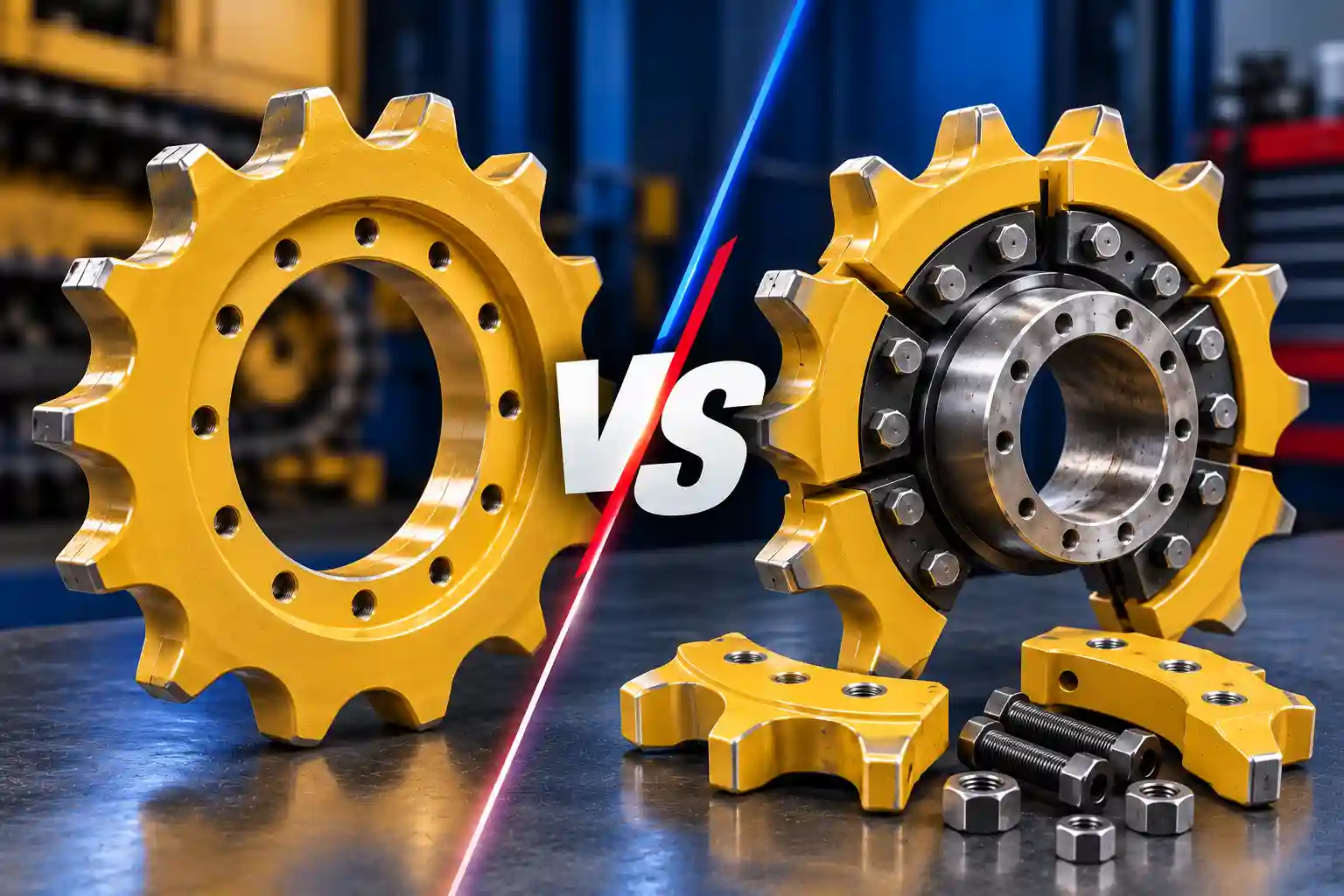
Every chain excavator drives its tracks through the sprocket. Every time the chain wraps around it, the sprocket teeth push against the chain bushings, and both lose a little metal. Over a few thousand hours that adds up, and it is the main reason new chains wear out early when they are fitted against old drive parts.
This guide covers segment group vs sprocket, what wears first, and what to replace together. It is aimed at owners and workshop teams who need to plan a rebuild without paying for the same job twice.
1. How the Sprocket and Track Chain Work Together
The sprocket sits at the rear of the track frame and is turned by the final drive. Its teeth engage the bushings of the track chain, pulling the chain around the frame. The chain, in turn, carries the shoes that grip the ground.
Both parts are in sliding contact all day, so both wear. The chain stretches as the pins and bushings wear, which makes the pitch longer. The sprocket teeth develop a corresponding wear pattern. When one part is new and the other is worn, the pitch no longer matches. The teeth then ride on the wrong spot of each bushing, and the new part starts to wear fast.
2. What Is a Segment Group?
On smaller machines the sprocket is a single wheel. On larger machines, especially dozers, the toothed rim is made in bolt-on pieces called segments. Each segment carries a few teeth, and a full set of segments forms the rim around a hub. This set is called a segment group.
The point of the design is practical. When the teeth wear out, you replace the segments without removing the hub from the final drive. It saves labour and downtime on heavy machines where lifting a whole sprocket is a big job.
| Point | Sprocket | Segment group |
|---|---|---|
| Construction | One-piece wheel with teeth | Bolt-on toothed segments on a hub |
| Common on | Most excavators | Dozers and large tracked machines |
| What you replace | The whole sprocket | The segment set or group, while retaining the hub |
| Labour | Lower on small machines | Lower on large machines |
| Typical sets | Per side, matched to chain pitch | Per side, in sets of five or nine segments in the range |
3. What Wears First?
In normal use the sprocket and chain wear at a similar pace. In practice, the order depends on the ground and how the machine is used.
• Abrasive sand and rock wear the outside of the chain bushings and the tips of the teeth.
• Packed mud and clay can pull the chain tight and raise wear on both.
• Frequent turning and reverse travel wear the sprocket on both faces of the tooth.
• A track that is too loose causes the teeth to ride high and wear unevenly.
As teeth wear, they become thin and hooked. A hooked tooth no longer releases the bushing cleanly, which raises noise and adds load on the final drive. If you see pointed or knife-edge teeth, the sprocket is near the end of its life.
4. Why Inspect the Sprocket When Replacing the Chain?
This is the question we hear most. Fitting a new excavator track chain over a worn sprocket seems like a saving, but it usually costs more.
A worn sprocket has teeth that no longer match the new chain pitch. The new bushings take the load on a small area and wear faster. In many cases the new chain loses a large share of its life within a few hundred hours. The reverse is also true. A new sprocket on a stretched chain wears out quickly because the pitch no longer lines up.
The sprocket or segment group should therefore be inspected whenever the chain is replaced. If the tooth profile is worn beyond the manufacturer’s limits, replace the drive component with the chain. The idlers and rollers should also be inspected because they operate against the same track chain.
5. What to Replace Together
| Job | Replace together | Check |
|---|---|---|
| New chain on a worn drive | Sprocket or segment group | Idler flanges and roller condition |
| New sprocket or segments | Chain if pitch is stretched | Chain pitch against OEM limits |
| Full undercarriage rebuild | Replace components that have reached their wear limits | Chain, sprocket or segments, idlers, rollers, shoes, bolts and track frame |
| Only teeth are worn | Segment group | Chain bushings for wear |
Wear limits vary by machine, so measure pitch and tooth wear against your OEM manual before deciding. A chain that measures within limits may be fine to keep, while a chain at its limit should never be paired with new drive parts.
6. Signs You Need to Replace the Sprocket or Segments
• Teeth are thin, pointed or hooked.
• Chain jumps or skips on the sprocket.
• Noise or vibration while travelling under load.
• Visible scoring or cracks on the teeth.
• Segment bolts loose or elongated holes in the segments.
• The chain sits deep between the teeth and does not release smoothly.
Catching these early lets you plan the rebuild with the chain, rather than reacting to a breakdown.
7. Choosing Replacement Undercarriage Parts
Start from the machine make and model, then confirm the chain pitch and the tooth count on the old part. Matching the model name alone is not enough, as sprockets differ between model years.
The Tuffex range lists 54 sprockets covering 50 models and 9 segment groups for dozer models such as the D6R and D8R. Tooth count and dimensions are provided on the sprocket listings where available. For example, the Berco sprocket for the 336 F L is listed with Z=23. A listing for the 320D L shows Z=21. If you are replacing the chain in the same job, there are 46 track link assemblies in the range. These undercarriage parts are all available with fitment details on the product pages.
Warranty on sprockets and segment groups is 6 months or 1,000 hours.