




Carrier Roller vs Track Roller: What Is the Difference?
Summary: About blog: Explains where the carrier roller and the track roller sit on a tracked machine, what each one carries, why their designs differ, and which one wears first. Includes a side-by-side table, wear signs and tips for matching a replacement to your machine.
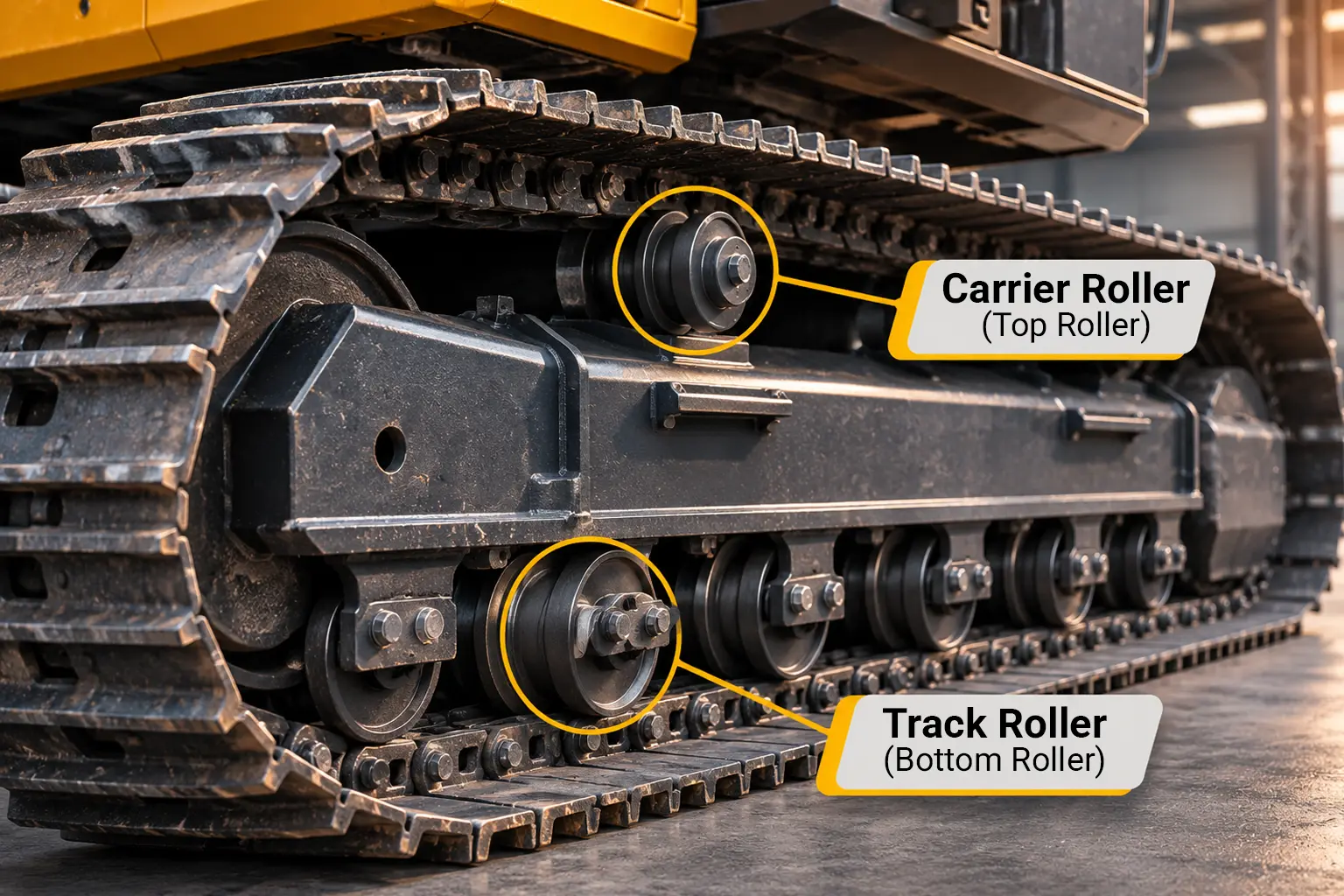
Every tracked excavator rides on two sets of rollers, and they get mixed up all the time. Both are steel rollers mounted on the track frame. Both turn as the chain moves past them. But they sit in different places, carry very different loads and fail in different ways.
This guide compares carrier roller vs track roller on position, load, design and wear, so you can describe a fault, read a parts list and order the right replacement. If you want the full list of undercarriage components first, read What Are Undercarriage Parts? Complete Guide to Excavator Undercarriage Components.
1. Carrier Roller vs Track Roller at a Glance
| Point | Track roller | Carrier roller |
|---|---|---|
| Also called | Bottom roller | Top roller |
| Position | Underneath the track frame, along the ground side | On top of the track frame |
| Main job | Carries the machine weight and guides the chain | Supports the upper run of the chain |
| Load | Heavy, shared with the other bottom rollers | Lower; supports the upper track or track-shoe assembly |
| Number per side | Several, depending on the machine | One or two on most excavators |
| Size | Typically larger, with wider flanges | Typically smaller and simpler |
| Wear rate | Faster | Slower |
Every row in this table follows from the first difference: one roller sits under the load and the other sits above the chain.
2. Where Each Roller Sits
Picture the track chain as a long loop. The lower run of the loop touches the ground. The upper run travels back over the top of the frame, between the sprocket and the idler.
The track roller sits inside the lower run. A row of them is bolted along the underside of the frame, between the sprocket end and the idler end. The chain links run on top of them, so the machine rests on the rollers and the rollers rest on the chain.
The carrier roller sits above the frame, in the upper run. The chain passes over it on the way back to the front.
3. What Each Roller Does
Track roller
Each track roller carries part of the machine weight and passes it into the chain and the ground. It also keeps the chain running straight, using flanges on either side of the link rail. If a bottom roller seizes, it stops turning and the chain drags across it instead of rolling over it, which damages both parts.
Carrier roller
The carrier roller has a much simpler job. The upper run of the chain is heavy, and without support it would sag and whip as the machine travels. The carrier roller holds the chain up and guides it back toward the idler.
Because it carries no machine weight, it usually lasts longer than a track roller. That does not make it maintenance-free. A worn carrier roller lets the chain sag and slap against the frame.
4. How the Designs Differ
• Size and bearing: track rollers have larger bodies and stronger shafts because they carry the load. Carrier rollers are smaller and lighter.
• Flanges: a track roller can have a single flange (SF) or a double flange (DF). Frames usually alternate the two so the chain is guided on both sides. Carrier-roller designs vary by machine and may be flanged or flat. Tuffex carrier-roller listings do not use the SF/DF classification.
• Sealing: both types are generally sealed and oil-lubricated. A leak in either one means the oil is escaping and the bearing is at risk.
The listings on the Tuffex site show this split. Of the 79 track rollers, 67 are listed as SF and 12 as DF. The carrier rollers carry dimension data and no SF or DF label.
5. Signs of Wear
| Roller | What to look for | What it means |
|---|---|---|
| Track roller | Oil leaking from the seal area | Seal failure, bearing about to go |
| Track roller | Flat spot or heavy scoring on the tread | Roller has seized or stopped turning |
| Track roller | Thin or sharp flanges | Chain no longer held in line |
| Track roller | Excessive play detected during inspection | Worn bushing or shaft |
| Carrier roller | Chain slapping against the frame | Roller worn or missing |
| Carrier roller | Squealing or grinding on the top run | Dry or seized bearing |
| Carrier roller | Flat tread | Roller has stopped turning |
Inspect both roller types. Track rollers typically wear faster because they carry the machine’s weight, but actual wear depends on operating conditions and maintenance.
6. Which One Wears Faster, and Why
The track roller wears faster for a simple reason: it carries the weight. Every metre of travel puts the full load through the same small contact patch between the roller and the link rail. Mud, sand and rock in the frame add to the wear.
Carrier rollers may last longer than track rollers, but their service life depends on operating conditions, track tension, contamination and maintenance. When a machine is in for a rebuild, check them anyway. A seized top roller is cheap to replace and expensive to ignore.
When one track roller fails, inspect all rollers on that side. Replace any rollers that are seized, leaking or beyond the manufacturer’s wear limits. Whether one or several rollers need replacement should be based on measured wear and the machine manufacturer’s guidance.
7. Matching the Right Roller to Your Machine
Roller sizes vary by model and sometimes by serial range, so a model name is only the start. Measure the old roller or read the dimensions on the listing before you order.
The Tuffex listings show the main measurements in a standard format:
• Track rollers are listed with A, B and D values, or with D and L, depending on the type. For example, a Berco track roller for the Volvo EC210D is listed with A=320, B=110 and D=19.5.
• Carrier rollers follow the same pattern. A carrier roller for the Tata Hitachi ZX210 is listed with A=90, B=36 and D=17.5, and one for the Volvo EC210D with D=46 and L=77.4.
• Check the flange type on a track roller, SF or DF, before you order.
The current Tuffex catalogue lists 79 track rollers and 63 active carrier rollers. Dimensions are shown on the listings where available.