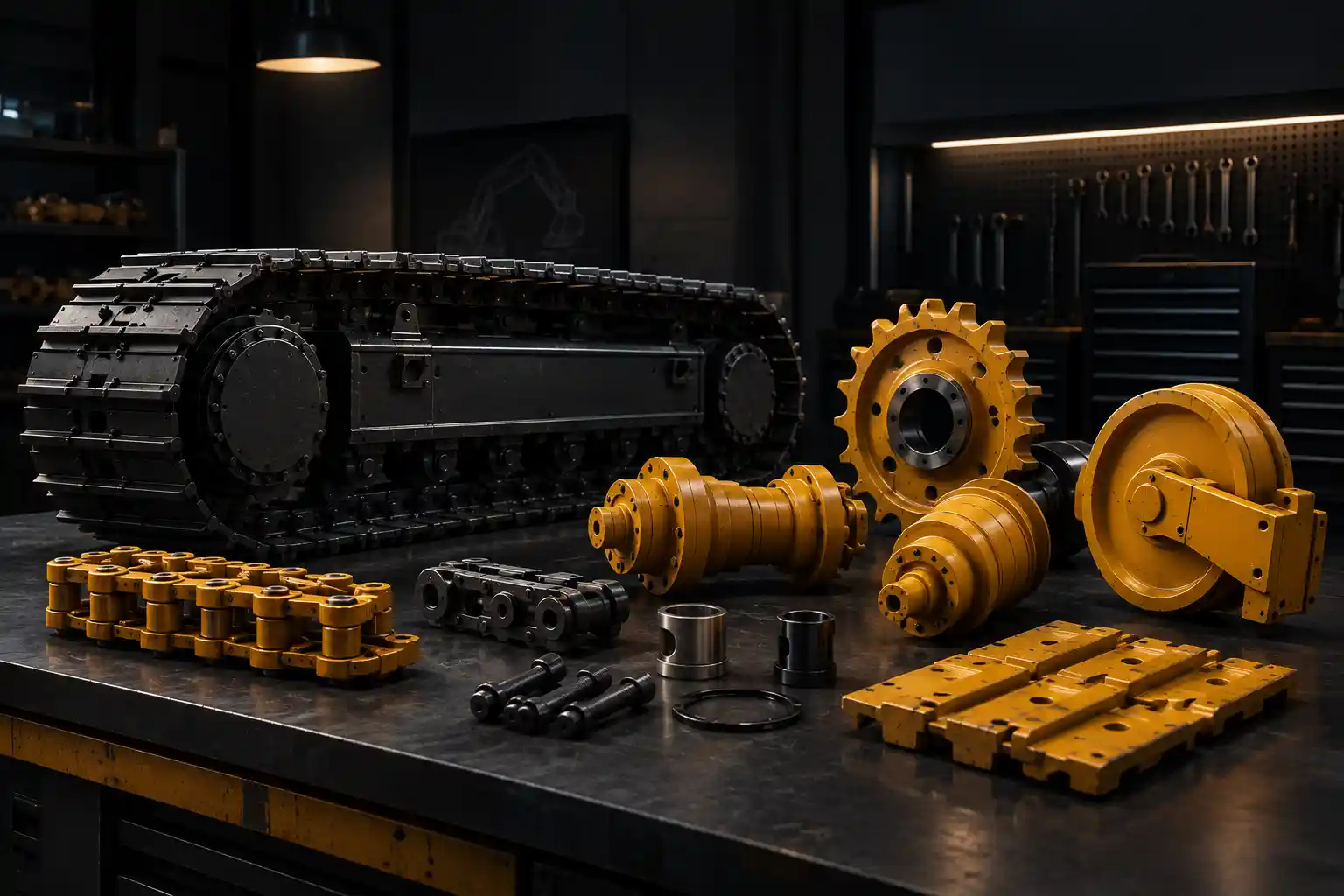




On a tracked excavator, there are no wheels touching the ground. The machine rides entirely on a closed loop of steel, and the system that forms, drives and supports that loop is the undercarriage. If you have searched for excavator undercarriage parts, undercarriage excavator parts or undercarriage parts of excavator, this guide covers what the system includes, why components wear together, and how to choose the right undercarriage replacement parts for your machine.
Because every undercarriage component works as part of the same system, wear in one part accelerates wear elsewhere. A loose track chain affects sprocket engagement. A seized roller drags and damages the chain rail. Understanding how the parts of undercarriage systems interact makes it easier to diagnose problems, plan replacement cycles and select the correct parts.
1. What Is an Excavator Undercarriage?
The undercarriage is the complete assembly below the machine's main body that supports and moves it. On a tracked excavator, it includes the track chain, track shoes, rollers, idler and sprocket, mounted on both sides of the machine. It carries 100% of the machine's operating weight plus the shock loads of digging, dumping and travel, directly against dirt, rock, mud and water, for every hour the machine runs.
Industry data consistently puts undercarriage components at 30-50% of a tracked machine's total lifetime maintenance cost - the single largest line item on the entire machine. This is why experienced fleet teams manage heavy equipment undercarriage parts as a planned cost per operating hour rather than waiting for a breakdown.
2. Main Excavator Undercarriage Components
An excavator undercarriage isn't one product - it's roughly eight interdependent part undercarriage types that wear together and typically get bought together.
2.1 Track Chain or Track Link Assembly
The backbone of the system: dozens of pinned steel links forming the loop the machine rides on. Wear starts internally, at the pin-and-bushing joints, and gradually stretches the chain's pitch until it stops meshing cleanly with the sprocket.
2.2 Track Shoe
The flat, grousered plate bolted to the outside of each link - the part that actually touches the ground. Shoe width and grouser pattern should match ground type: wider shoes for soft or wet ground, narrower and more aggressive grousers for rock.
2.3 Track Roller (Bottom Roller)
Mounted underneath the track frame, carrying the machine's full weight onto the chain and guiding it in a straight line. A seized roller drags across the chain instead of rolling, damaging both.
2.4 Carrier Roller (Top Roller)
Sits on top of the frame, supporting the upper return strand of the chain so it doesn't sag or whip. It carries less load than a bottom roller, so it typically lasts longer.
2.5 Idler Assembly
A large wheel at the end of the frame, paired with a tensioning mechanism, that the chain wraps around and that sets track tension. A failed idler causes chain slack, mis-tracking and a real risk of the track coming off entirely.
2.6 Sprocket
The only powered part in the system, driven by the final drive motor. Because it transmits drive force, it wears in step with the chain, which is why the two are always sold and replaced as a matched pair.
2.7 Segment Group
On dozers, the sprocket's outer, tooth-bearing rim is often a bolted-on segment set rather than one solid casting, so only the worn teeth need replacing, not the whole hub.
2.8 Track Shoe Bolts and Nuts
Torque-rated fasteners holding each shoe onto its link. Standard workshop practice is fresh bolts every time shoes are removed, since reused, fatigued bolts risk failing again soon after.
3. Common Signs of Undercarriage Wear
- Excessive track sag that doesn't correct with adjustment
- Track slip, jumping or poor sprocket engagement
- Oil leakage, flat spots or seizing on rollers
- Persistent tension loss that re-adjustment can't fix
- Cracked, bent or missing track shoes, or elongated bolt holes
- The machine "walking" off-line or repeated detracking
Any one of these is worth an inspection of the full loop - not just the part showing the obvious symptom - since wear in one component accelerates wear in its neighbours.
4. Why Matched-Wear Replacement Matters
A machine's condition is often described as a single figure - "this machine has 40% undercarriage left" - measured across chain pitch, shoe height, roller wear and sprocket tooth profile together, never any one part alone. Matched-wear replacement - chain with sprocket, shoes with fresh bolts - is treated as close to a rule rather than a suggestion in the trade: installing a new chain against old, worn sprocket teeth makes the new part fight a mismatched partner and wear out abnormally fast.
5. OEM vs. Premium Aftermarket vs. Value Aftermarket
Buyers of aftermarket undercarriage parts are generally choosing between three tiers. OEM parts are the highest-priced, exact-factory-spec option, sold through the machine dealer. Premium aftermarket brands are engineered to OEM-equivalent tolerances at a meaningfully lower price - a no-compromise substitute for most fleets. Value-tier aftermarket parts are built to a lower price point for cost-sensitive, high-hour operations where the owner is optimising cost-per-hour of use rather than buying the longest-lived part money can buy. The right choice depends on the machine's age, how long it's staying in service, and how the fleet manages its maintenance budget. None of the three tiers is automatically the wrong call; the job is matching the tier to how the machine is actually being used.
6. How to Select the Right Construction Equipment Undercarriage Parts
Fitment is exact in this category - dimensions, section counts, pitch, tooth count and bolt-hole patterns all have to match the specific machine model. A part undercarriage buyer should always confirm the exact machine make and model before ordering, check whether the part is due for matched-wear replacement alongside its paired component, match shoe width and grouser pattern to the ground condition the machine works in, and confirm warranty terms before ordering.
Frequently Asked Questions
- What are the main parts of an excavator undercarriage?
- The core components are the track chain, track shoes, track rollers, carrier rollers, the idler assembly, the sprocket, and - on dozers - the segment group, along with the track shoe bolts and nuts that hold everything together.
- Why do undercarriage parts wear out faster than other machine parts?
- The undercarriage runs in constant, direct contact with abrasive dirt, rock and moisture while carrying the machine's full weight and shock loads - far harsher than most other systems on the machine.
- Should I replace undercarriage parts individually or as a set?
- Where possible, replace matched-wear pairs together, since mixing new and worn components in the same wear pair accelerates wear on the new part.
- Is the aftermarket as reliable as OEM for undercarriage parts?
- It depends on the tier. Premium aftermarket brands are built to OEM-equivalent tolerances; value-tier aftermarket parts trade some service life for a lower price point, which suits fleets optimising cost-per-hour over years-per-part.