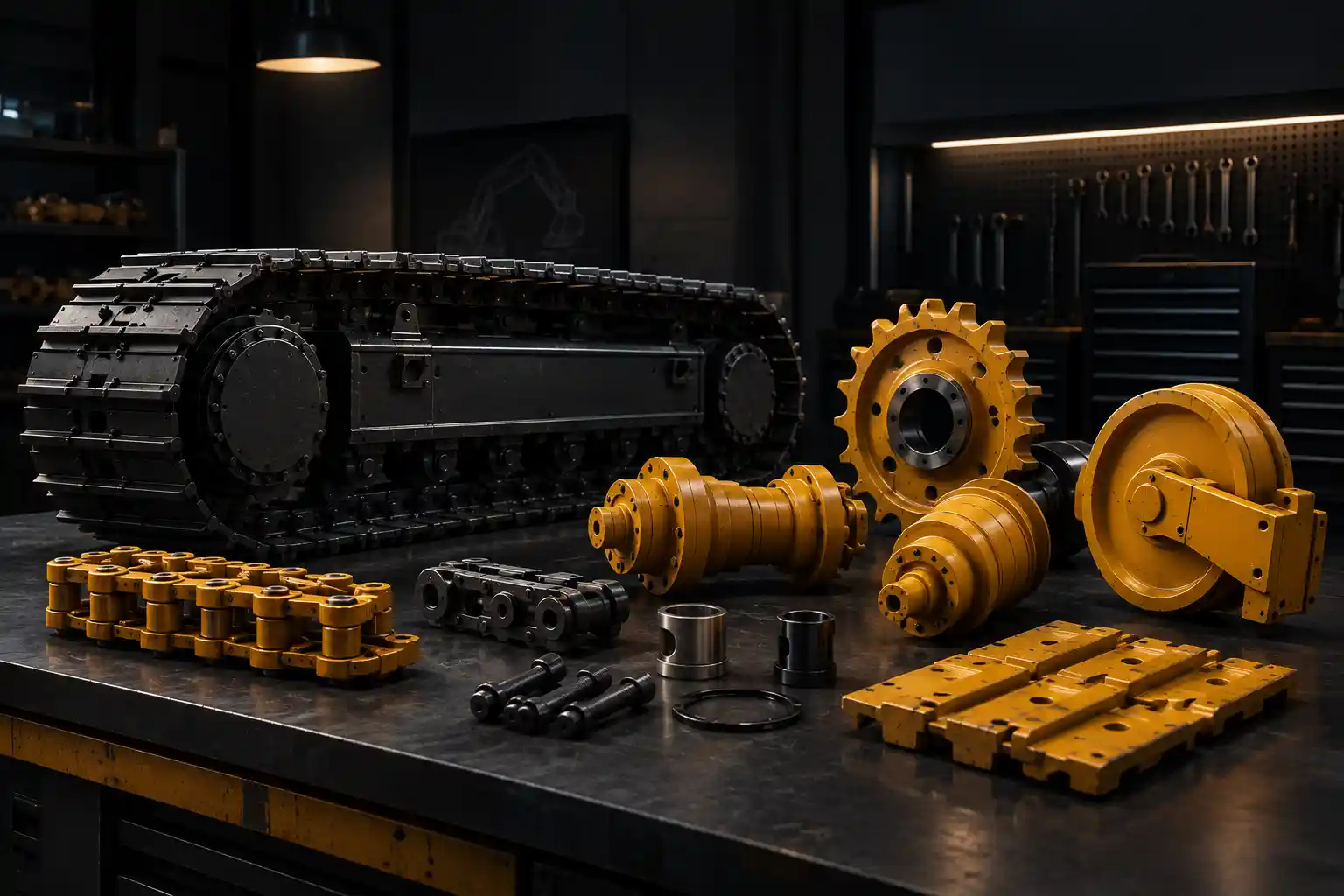




Track chain, chain tracks, chain excavator, track chain excavator, digger track chains, dozer chain: the same component picks up different names depending on who's talking about it and which machine it's on. This guide covers what a track chain actually is, how it works, how to read wear before it becomes a failure, and when replacement is the right call.
1. What Is a Track Chain?
A track chain, also called a track link assembly, is the closed loop of pinned steel links that a tracked machine rides on. It's the backbone of the undercarriage: every other undercarriage component, the sprocket, rollers, idler and shoes, either drives the chain, carries weight onto it, or bolts directly to it. Without the chain, none of those other parts have anything to act on. On a mini excavator this might be a lighter, narrower-pitch chain; on a large dozer or mining excavator it's a heavy-duty assembly built to handle far greater loads, but the underlying principle, a closed loop of pinned links, is the same across the entire size range.
An excavator track chain and a dozer chain both work on the same basic principle, even though the two machines put very different demands on it, covered further down.
2. How Does a Track Chain Work?
Each link in a track chain is joined to the next by a pin and bushing pair, forming a continuous loop around the sprocket at one end and the idler at the other. The sprocket, the only powered component in the system, engages teeth into the chain and physically drives it around the loop. As the chain moves, the track rollers underneath carry the machine's weight onto it, and the shoes bolted to the outside provide the grip against the ground.
That pin-and-bushing joint is also where wear actually happens. Every time the chain flexes around the sprocket and idler, the pin and bushing rotate slightly against each other, and over thousands of cycles that internal wear is what eventually stretches the chain. Dirt, grit and moisture accelerate this wear by working their way into the pin and bushing joint, which is exactly why the seal design at that joint, covered in the next section, matters as much as the steel itself.
3. Dozer Chain vs. Excavator Chain
A bulldozer chain and an excavator chain look similar but wear differently, because the two machines use them in different ways.
| Factor | Dozer chain | Excavator chain |
|---|---|---|
| Primary wear driver | Near-continuous propulsion; the machine is moving most of the working day | Frequent swing and short travel moves between digging positions, with more static dwell time |
| Typical sealing | Often SALT (sealed and lubricated track) chains, oil-filled to reduce internal pin and bushing friction | Commonly sealed with polyurethane or elastomer seals to keep abrasive material out of the pin joint |
| Sprocket wear pattern | Wears relatively quickly due to constant drive cycling | Can run far longer between sprocket replacements on the same machine |
Neither type is "tougher" in an absolute sense, they're engineered for different duty cycles, which is also why a dozer chain and an excavator chain are never interchangeable even when the machines are a similar size.
This distinction also explains a pattern many fleet managers notice without necessarily knowing why: a dozer working double shifts on a grading job can burn through a chain noticeably faster than an excavator of similar size doing trenching work, even though both machines log similar operating hours. The chain is responding to how the machine actually moves, not just how long it runs.
4. Understanding Track Chain Elongation
Track chain elongation, or pitch elongation, is the single most important wear measurement on the whole undercarriage. As the pin and bushing wear internally, each link grows very slightly longer, and across dozens of links that adds up to a measurable stretch in the chain's overall pitch.
- Pitch elongation is measured across a multi-pin span and calculated as (measured pitch minus new pitch), divided by new pitch, expressed as a percentage.
- Most OEMs set a replacement threshold in the 2-4% range, though the exact figure varies by manufacturer and machine class, so the operator's manual is the authoritative source.
- Once pitch elongation crosses that threshold, the chain no longer meshes cleanly with the sprocket, and wear on the sprocket teeth accelerates sharply.
This is also why sprocket and chain are treated as a matched pair. A stretched chain running against sprocket teeth cut for a shorter pitch wears both parts out far faster than either would wear on its own.
5. When to Replace a Track Chain
Knowing when to replace track chain components starts with the elongation measurement, but a few practical signs usually show up before a chain is measured formally.
- Visible looseness or sag in the track that re-tensioning doesn't fully correct
- The chain skipping or jumping on the sprocket, especially under load
- Audible clicking or knocking as the chain runs, distinct from normal operating noise
- Uneven or accelerated wear on the sprocket teeth, since a stretched chain wears its sprocket faster
Any one of these on its own is worth a proper pitch measurement rather than a guess. Replacing a track chain slightly early, once it's approaching but hasn't yet crossed the OEM threshold, is almost always cheaper than replacing a chain, a sprocket and a set of rollers together after the wear has cascaded.
6. Track Chain Coverage at Tuffex
Tuffex stocks track link assemblies across both dozer and excavator ranges, spanning multiple brands and machine manufacturers, from premium aftermarket tiers like Berco and ITM through to Tuffex's own value-tier house brand. Coverage spans dozer models alongside a wide range of excavator models across several OEMs, so a fleet running mixed dozer and excavator equipment can typically source both chain types from the same supplier.
As with any undercarriage part, exact fitment depends on the specific machine model and pitch specification, so confirming the model before ordering remains the safest step.
Frequently Asked Questions
- What's the difference between a track chain and a track link assembly?
- They're the same component. Track link assembly is the more formal, catalogue-style term; track chain is the common name used on site.
- How does a track chain work with the sprocket?
- The sprocket's teeth engage the chain's links and physically drive it around the loop. Because the sprocket is the only powered part in the system, it wears in step with the chain, which is why the two are replaced as a matched pair.
- When should I replace a track chain?
- Most manufacturers set a replacement threshold in the 2-4% pitch elongation range, though the exact figure varies by OEM. Visible sag, chain skipping on the sprocket, and accelerated sprocket tooth wear are practical signs worth checking before that measurement is taken.
- Can a dozer chain be used on an excavator, or vice versa?
- No. Dozer chains and excavator chains are engineered for different duty cycles and are not interchangeable, even between similarly sized machines.