




Track Chain Elongation: How to Measure It and What the Numbers Mean
Summary: About blog: A step-by-step guide to measuring track chain elongation. Covers what to measure, how to calculate the percentage, a worked example using real chain pitch values, and what each result means for the chain and the sprocket.
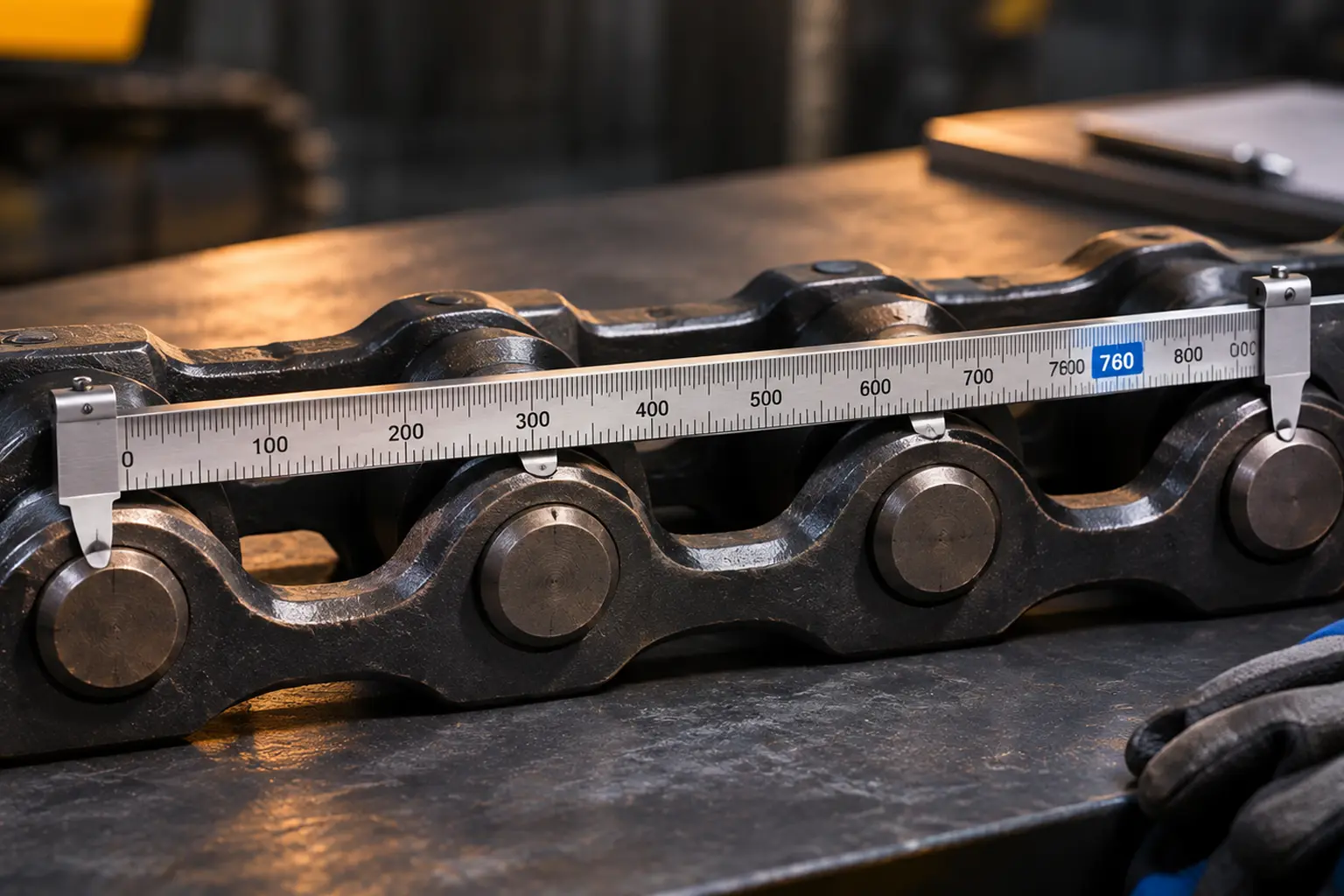
A track chain does not stretch like rubber. It gets longer because the pins and bushings inside each joint wear, and every joint adds a tiny amount. Across dozens of links, those tiny amounts add up to a chain that no longer fits its sprocket.
The only way to know how far that has gone is to measure it. This guide shows how to take a track chain elongation measurement, how to turn it into a percentage, and what the result tells you. For the background on how a chain is built, read What Is a Track Chain and How Does It Work? Function, Wear & Replacement.
1. Why Elongation Matters
As the chain grows, the distance between each pin gets longer than the distance between the sprocket teeth. The bushings stop seating in the root of the tooth and start riding up its flank. That hooks the teeth and speeds up wear on both parts.
So the percentage you measure does two jobs. It shows how far the chain pitch has extended and, when compared with the OEM wear limit and previous readings, helps you estimate its remaining service life. It also warns you about increasing wear at the sprocket interface.
2. What You Need
• A steel tape or a pitch gauge made for your chain.
• A wire brush and a scraper to clean the pins.
• A level, firm surface.
• The new-chain pitch for your model, from the manual or the parts listing.
• A notebook or phone to record the result.
3. How to Measure Step by Step
• Clean the chain so the pin ends and bushings are visible.
• Set the track to the correct tension. A slack chain gives a false reading, so check sag first.
• Pick a straight section of chain on the upper run or on the ground side, where the chain lies flat.
• Measure between the centres of two pins across the number of pitch intervals specified by the OEM. For example, measuring from the first pin centre to the fifth pin centre covers four pitch intervals.
• Divide the reading by the number of pitch intervals to calculate the average pitch, or compare the complete measured span with the corresponding new-chain span.
• Repeat the measurement at the locations specified by the OEM and record the readings consistently.
• Measure both sides.
Use the same method each time. If you change the span or the section, the readings cannot be compared.
4. How to Calculate the Percentage
The formula is simple:
Elongation % = (measured length minus new length) divided by new length, times 100.
The new pitch for your chain comes from the OEM specification. The Tuffex listings for track link assemblies show it as the P value, together with the number of sections. A few examples from the listings:
| Chain pitch (P) | Listed for | New length over 4 pitch intervals |
|---|---|---|
| 190 mm | PC200, EC210D, ZX210 (49 sections) | 760 mm |
| 203.2 mm | D6R, D65, D85 | 812.8 mm |
| 215.9 mm | D80, D85A-18, EC380DL | 863.6 mm |
| 216 mm | PC300, PC350 (48 sections) | 864 mm |
A worked example
Take a chain with a 190 mm pitch, measured over four pitch intervals. The new length is 4 x 190 = 760 mm. Suppose the tape reads 782.8 mm.
Elongation = (782.8 minus 760) divided by 760, times 100 = 3.0 percent.
The numbers in this example are for illustration. Your own reading depends on your machine, and the span and limit come from your manual.
5. What the Numbers Mean
| Reading | What it means | What to do |
|---|---|---|
| Well below the OEM limit | Pitch extension remains below the OEM wear limit | Keep measuring at each service |
| Approaching the limit | Chain is close to the end, sprocket teeth are starting to wear | Plan the replacement and check the sprocket |
| At or above the limit | Chain no longer meshes cleanly | Follow the OEM recommendation for replacement or permitted servicing, and inspect the sprocket, bushings and idler |
The limit differs by maker, chain type and machine, so the figure in your manual is the one that counts. A chain at its limit can still look fine on the outside.
6. Internal Wear and Bushing Turning
Elongation comes from wear inside the joint, at the contact surfaces between the pin and the inside of the bushing as the chain articulates. The outside of the bushing is where the sprocket teeth wear it, and the two kinds of wear are linked.
On chains designed for it, bushings can be turned to bring a fresh surface into contact with the sprocket. This may extend service life when performed within the manufacturer’s permitted wear limits. Not every chain is designed for pin-and-bushing turning, so confirm the procedure and timing with the OEM or a qualified undercarriage specialist.
Sealed and lubricated chains are built to slow wear inside the joint. A track-chain joint with a damaged seal can lose lubricant and allow contamination to enter, reducing that protection, so look for oil or dry, squealing joints as well as measuring pitch.
7. Habits That Speed Up Elongation
• Tracks run too tight, which adds load to every joint.
• Abrasive ground such as sand and grit working into the links.
• Packed mud and clay that is not cleared, which tightens the track between services.
• Long hours of travel, since joint wear follows distance moved.
Reducing these wear factors will not eliminate elongation, but it may extend the chain’s service life.
8. Keep a Record
One reading tells you where the chain is today. A series shows how fast it is changing. Record the date, machine hours, side, span and measured length every time.
| Date | Hours | Side | Span | Measured | Elongation % |
|---|---|---|---|---|---|
| Example | Left | 4 links |
With consistent readings over time, you can estimate when the chain may reach its wear limit, and order the parts before the machine stops.
9. When to Replace and What to Replace With It
When the chain reaches its limit, check the sprocket at the same time. A new chain on a worn sprocket wears quickly, and so does a new sprocket on a stretched chain. For an explanation of why these parts should be inspected together, read Sprocket vs Segment Group: What Wears First and What to Replace Together.
The current Tuffex catalogue lists 46 track link assemblies. Each listing shows the pitch (P), the link dimensions and the number of sections where available, so you can match the new chain to the old one.