




Spare Parts Inventory Planning: What a Fleet Should Keep in Stock
Summary: About blog: A practical method for spare parts inventory planning on a heavy equipment fleet. Covers ranking parts by what happens when they run out, working out minimum stock from lead time, and choosing parts that fit more than one machine.
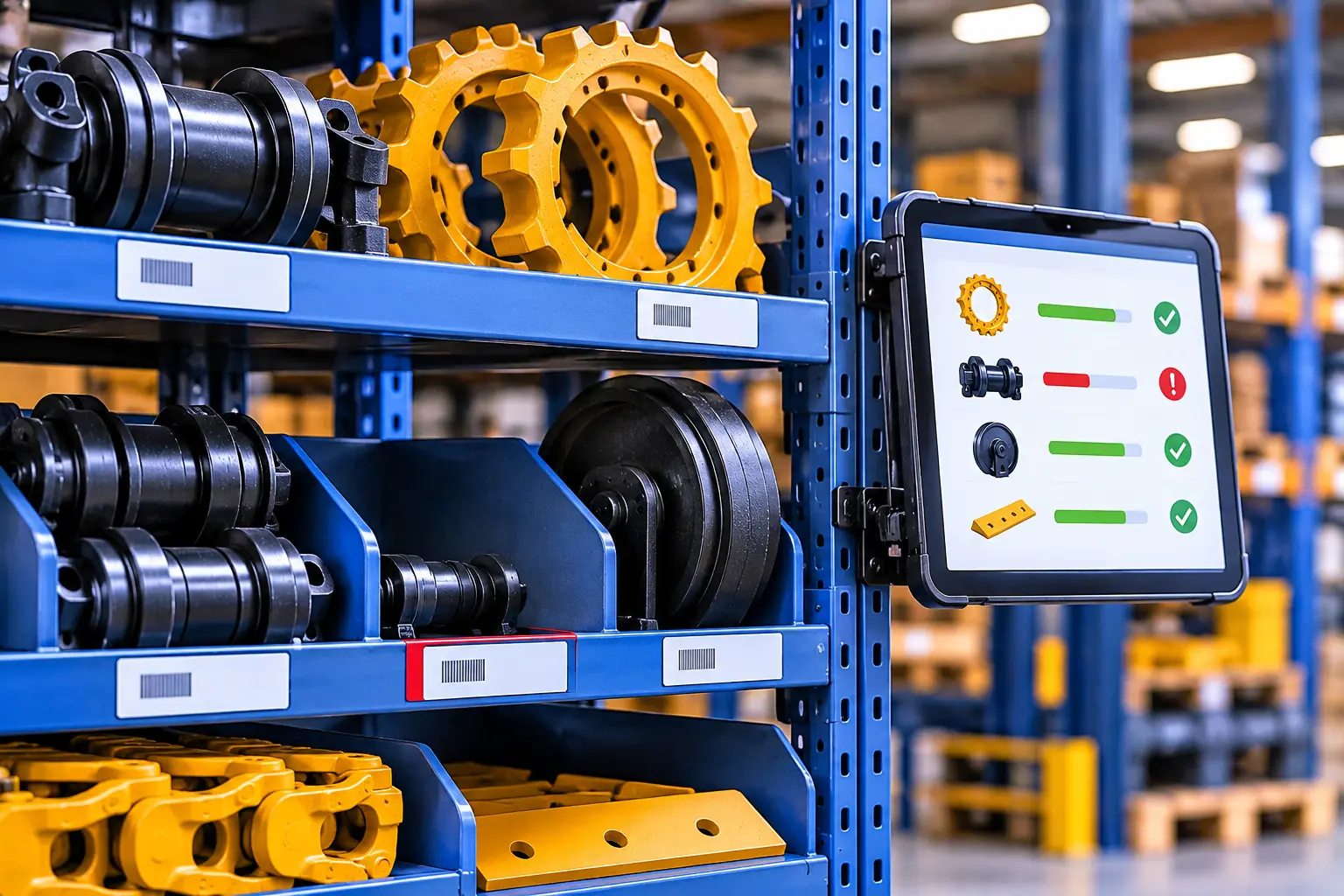
Stock too little and a machine waits for a part. Stock too much and money sits on a shelf. Spare parts inventory planning is the work of finding the middle, so that the parts you need are there and the ones you do not need are not.
This guide gives a simple method that a fleet of any size can follow. It uses three questions: what happens when this part runs out, how long does it take to get, and how many machines does it serve?
1. Start with What Happens When It Runs Out
Not every part deserves the same stock. The useful ranking is by consequence. Ask what happens to the job if the part is not there.
| Group | What happens without the part | Stocking approach |
|---|---|---|
| A: Stops the machine | The machine cannot work | Hold stock and set a firm minimum |
| B: Slows the machine | Output drops, but work continues | Hold a modest stock, sized to usage |
| C: Can wait | No immediate operational impact | Buy when needed |
Where each part falls depends on your site. A tooth point may be group B on one machine and group A on a machine with no spare bucket. Decide by consequence, not by price.
2. Use Wear Records Alongside Usage History
Past orders and usage history are useful, but they may not fully reflect future requirements. A critical part can show little historical usage and still be needed urgently when it wears out or fails.
Use your own wear and service records instead. They show how often each part is replaced and how fast it wears. If you do not have records yet, start by noting each replacement. The habit builds the data.
3. Let Lead Time Set the Reorder Point
A simple reorder point equals the expected demand during the replenishment lead time plus the chosen safety stock. The safety stock should reflect uncertainty in usage and supplier lead time.
| Step | Example (for illustration only) |
|---|---|
| Usage | 4 tooth points a month |
| Lead time | 3 weeks |
| Expected lead-time demand | Approximately 3 tooth points |
| Safety stock | 1 tooth point |
| Reorder point | 3 + 1 = 4 tooth points |
| Action | Reorder when available stock reaches the reorder point |
The numbers are an example of the method. Use your own usage and your supplier's real lead time. If the lead time is long or uncertain, raise the safety margin.
4. Stock Parts That Fit More Than One Machine
Every extra part number is another item to store and track. A part that fits several models does the work of several. Look at your fleet and find where models share parts.
| Part | Listed for |
|---|---|
| Track link assembly, 190 mm pitch, 49 sections | PC200, EC210D, ZX210 and other models |
| Track shoe, 600 mm | 320D L, SY210, SK210, JS220 |
| Cutting edge, 25 mm | D80A-18 and D85A-18 |
| Grader blade | 12H and 120H |
In the current Tuffex Product Master, 163 of the 462 active product listings name more than one compatible machine. Check the compatible models on each listing and the dimensions before you rely on a shared part.
A starting point for a tracked excavator fleet
| Parts | Suggested group | Note |
|---|---|---|
| Tooth points and adapters | A or B | A if the bucket has no spare and digging stops without them |
| Cutting edges and end bits | B | Order at the planning stage |
| Track rollers and idlers | A or B | Depends on failure consequence, usage, shared fleet fitment and supplier lead time |
| Sprockets and track chains | A or B | Plan and inspect them as a matched system; replace according to measured wear and OEM guidance |
| Track shoes | B or C | Depends on bolt and shoe condition |
Treat this as a first draft. Your own records should correct it within a few months.
5. Keep Parts That Wear Together in Step
Some parts should not be stocked alone. A worn sprocket can accelerate wear on a new chain, so inspect the chain and sprocket as a matched system and plan replacement according to their measurements and the manufacturer’s guidance. The reasons are in Sprocket vs Segment Group: What Wears First and What to Replace Together.
For the order in which parts wear, read Planning Wear-Part Replacements: Which Excavator Parts Wear Fastest. Use it to decide which parts need the deepest stock.
6. Do Not Write Off Slow Movers Too Quickly
A part that has not moved in a year is not always waste. It may be a critical spare that simply has not been needed yet. Judge it by consequence and frequency together.
| Consequence | How often used | What to do |
|---|---|---|
| High | Rarely | Keep one unit |
| High | Often | Keep full stock |
| Low | Rarely | Buy when needed, or release the stock |
| Low | Often | Review supply terms |
7. Store Parts Properly
- Label each part with its part number and the machines it fits.
- Keep steel parts dry and off the floor, since rust starts early in damp weather.
- Store heavy parts on load-rated racks or stable supports at a low, safely accessible level, using appropriate lifting equipment where required.
- Keep the packing slip or listing details with the part.
Damp months raise the risk. The seasonal checks are covered in Monsoon, Dust and Heat: Seasonal Care for Heavy Equipment Wear Parts.
8. Review Every Quarter
Stock rules go out of date. Lead times change, machines are added or retired, and the work moves to different ground. A short review each quarter keeps the list honest.
- Compare actual usage with the minimums.
- Check supplier lead times again.
- Add parts for new machines and remove those for retired ones.
- Look at what was bought in a hurry, and ask why.
9. A Starting List for This Week
You do not need a full system. Start small:
- List the machines in the fleet and their models.
- Write down the parts replaced in the last year, from service notes.
- Mark each as A, B or C.
- Set a minimum for the A parts using the lead-time rule.
- Order what is missing.
That is enough to cut the most expensive surprises. Once it is running, add the next tier of parts, and keep the list on one page so the whole team can use it.