




Planning Wear-Part Replacements: Which Excavator Parts Wear Fastest
Summary: About blog: A guide to which excavator parts wear fastest and how to plan for them. Covers the wear-rate order of ground engaging parts and undercarriage, how often each needs checking, and how to group replacements into fewer stops.
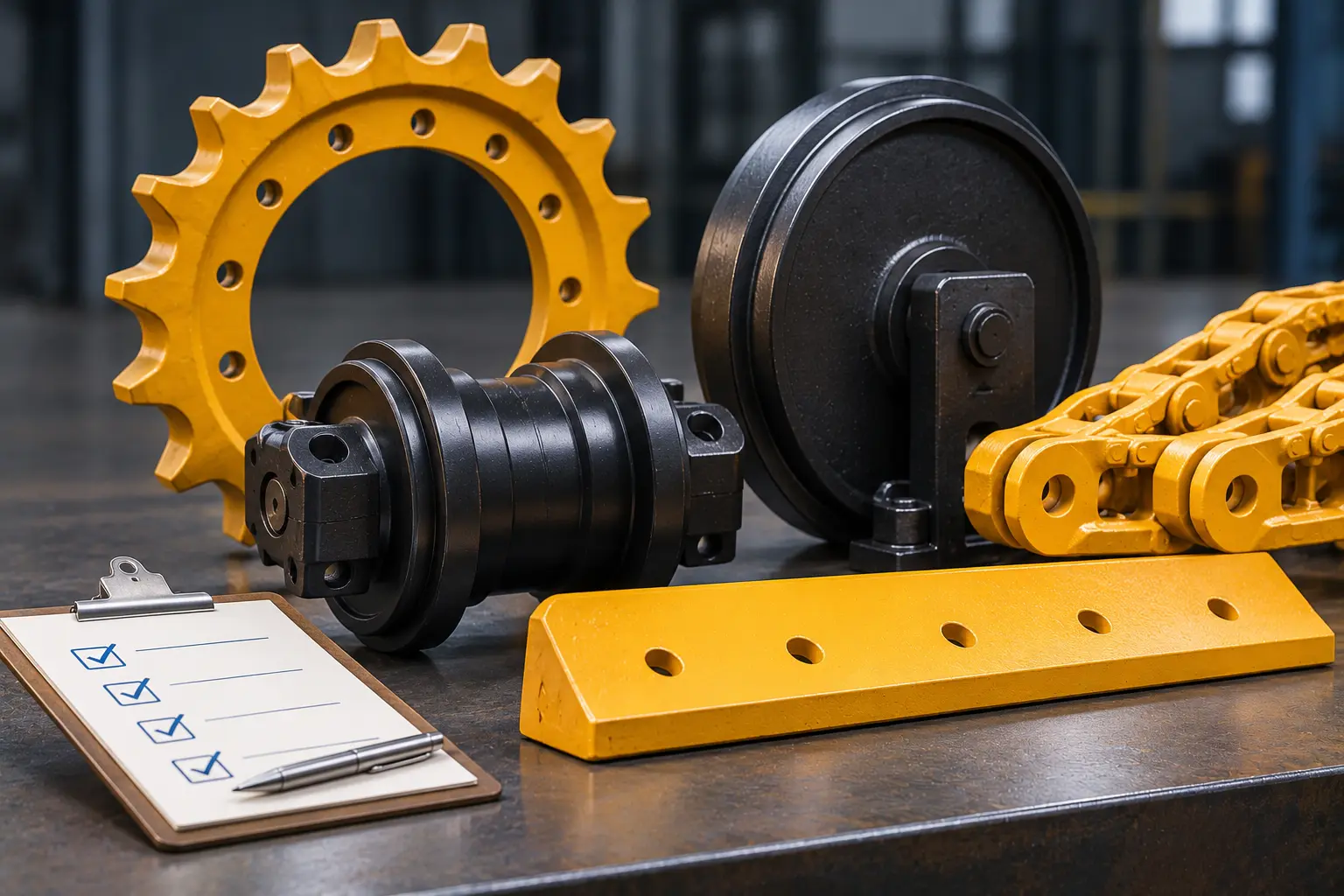
Every excavator has parts that are meant to wear out. Some last weeks, some last years. If you know the order, you can plan around it. If you do not, the machine decides the order for you, usually at the worst time.
This guide ranks the main wear parts by how quickly they wear, shows how often to check each, and explains how to group replacements so the machine stops less often.
1. Which Excavator Parts Wear Fastest
The parts that touch the ground wear first. Anything that digs, scrapes or carries weight against dirt and rock loses material with every working hour. A typical order is shown below, although ground conditions, machine application and operating practices can change the ranking:
| Group | Examples | How fast it wears | Why |
|---|---|---|---|
| Digging contact parts | Tooth points, adapters, cutting edges | Fastest | They cut and scrape the ground directly |
| Undercarriage moving parts | Track rollers, idlers, sprockets, chain, track shoes | Steady | They carry the machine and move over the ground |
| Fasteners and seals | Bolts, seals, hoses | Varies | They fail from vibration, heat and age |
Undercarriage parts are also among the most worn components, which is why they are checked daily on many fleets.
2. Digging Contact Parts
Bucket teeth take constant abuse. They become worn down, dull or loose, and they need inspection on every walk-around. The tooth point is usually the first part in the bucket to need replacing.
Adapters sit behind the tooth point and wear more slowly. Cutting edges and end bits protect the lip between the teeth. For sizing and ordering, read How to Identify Bucket Teeth Size and Type Before You Order.
On dozers and graders, the cutting edge plays the same role. For wear limits, read When to Replace a Cutting Edge: Wear Limits for Dozer and Grader Blades.
3. Undercarriage Parts
The undercarriage carries the whole machine, so its parts wear steadily rather than suddenly. The track chain’s pitch increases as its pins and bushings wear, the sprocket teeth wear, and the rollers and idlers lose material on their running surfaces.
They also wear together. A worn chain can accelerate wear on a new sprocket, so the chain and sprocket should be assessed as a matched system and replaced together where their measurements and the manufacturer’s guidance indicate. The reasoning is in Sprocket vs Segment Group: What Wears First and What to Replace Together.
4. Fasteners, Seals and Hoses
These are not always called wear parts, but they fail like them. Bolts loosen under vibration. Seals wear and leak. Hoses deteriorate with age, heat, pressure, abrasion and movement, so their condition should be checked at the intervals specified by the manufacturer.
Their failures can stop a machine as completely as a worn track, so they belong in the plan. A failed hydraulic hose disables the controls. A leaking roller seal can cause lubricant loss and may eventually lead to roller failure or seizure.
5. How Often to Check Each Part
The table below is a general planning framework. Follow the inspection and service intervals specified in the machine’s OEM manual.
| Check | Parts | How often |
|---|---|---|
| Walk-around | Teeth, bolts, leaks, track condition | Start of each shift |
| Service interval | Track sag, chain pitch, roller and idler wear, sprocket teeth, cutting edges | At the OEM-specified service interval |
| Seasonal | Everything above, plus seals, hoses and cooling | Before significant seasonal or operating-condition changes |
The method for chain pitch is in Track Chain Elongation: How to Measure It and What the Numbers Mean.
6. Plan Replacements Around Wear Order
Once you know the order, planning is a matter of sequence.
- List the wear parts on your machine, from teeth to undercarriage.
- Check them at the intervals above and record the result.
- Rank them by how close they are to their limits.
- Order the parts that are close to the limit first.
- Group the work, so one stop covers several parts.
7. Group Replacements into Fewer Stops
Each stop costs time, labour and lost working hours. Grouping suitable jobs into one planned stop can reduce repeated downtime and labour.
Good groupings include:
- Chain and sprocket together, since they wear as a pair.
- Tooth points and adapters in the same visit, so the adapter can be inspected while the tooth is off.
- Cutting edge and end bits together on a blade.
- Rollers and idlers inspected during other undercarriage work on the same side.
A simple planning sheet
| Part | Status | Action |
|---|---|---|
| Tooth points | Watch | Check every shift, order the next set |
| Cutting edge | Good | Measure at the next service |
| Track rollers | Watch | Check seals and wear at the service |
| Chain and sprocket | Order now | Replace together at the next stop |
The entries here are only an example of the layout. Fill the sheet from your own readings.
8. Let the Ground Adjust the Order
The ranking above is a starting point. Your ground can change it. Abrasive sand pushes the undercarriage up the list. Rock puts more load on teeth, shoes and bolts. The comparison is in Terrain and Undercarriage Wear: Rock, Sand, Mud and Slopes Compared.
Review the order once a year, or whenever the machine moves to a different type of work.
9. What Planning Gives You
- Fewer sudden stops, because worn parts are found before they fail.
- Lower cost per stop, because several jobs share one visit.
- Less waiting for parts, because orders go in early.
- A clearer budget, because you can see what is coming.
10. Common Planning Mistakes
- Planning by hours alone and ignoring the ground the machine works on.
- Leaving small parts such as bolts and seals off the plan.
- Ordering after the failure instead of before it.
- Fitting a new part against a worn partner.
11. Plan for Lead Time
A part that is out of stock can keep a machine waiting. The cost of a day of downtime is high, and waiting for a part can stretch it. Order at the planning stage, not at the failure stage.
Tuffex lists 11 tooth points, 11 adapters, 21 cutting edges, 20 end bits and a wide range of undercarriage parts, with dimensions on each listing where available. That helps you match the part before you order.
12. Where to Start This Week
You do not need a full system on day one. Pick the machine that works hardest. Write down its wear parts, check each one against the OEM limit, and mark the two that are closest. Order those first.
Repeat the same check at the next service. After two or three rounds, you have a working plan and a record of how fast each part is wearing.